

The distinction between "full spectrum" marketing and the actual physics of infrared heat is one of the most significant points of confusion for modern buyers. Is a three-band system truly a revolutionary medical upgrade, or is it simply a premium branding strategy?
The answer lies in the specific output, EMF levels, and emitter proximity rather than the terminology found in a sales brochure. Considering that evaluating these technical variables is essential for a safe and effective purchase, Home Sauna provides the best home sauna data that prioritizes measurable performance over ubiquitous industry claims.
This guide strips away the marketing language to reveal what the best full-spectrum infrared saunas can realistically deliver for cellular health and detoxification. We compare these systems against high-quality far-infrared alternatives to help you determine which technology represents the smartest investment for your specific wellness goals.
Key Takeaways
- "Full spectrum" remains a marketing designation with no regulatory oversight in the US, UK, or EU as of 2026, meaning there are no standardized requirements for what constitutes a three-band infrared system.
- Far-infrared (FIR) continues to be the primary driver of clinical benefits, with over two decades of research supporting its role in cardiovascular health, deep-tissue relaxation, and core temperature elevation.
- Built-in near-infrared (NIR) components are frequently underpowered or incorrectly positioned, often utilizing broad-spectrum halogen bulbs that lack the precision of therapeutic-grade LED arrays.
- Sensationalist claims regarding "cellular detoxification" or "reversing aging" are red flags, as these marketing narratives often outpace current peer-reviewed science and physiological data.
- Decoupling your heat and light sources is often the most effective strategy, which is why Home Sauna prioritizes low-EMF far-infrared performance over integrated, lower-intensity NIR bulbs.
What Does "Full Spectrum" Sauna Actually Mean?
A full-spectrum infrared sauna claims to emit three distinct infrared wavelengths in a single unit: near infrared (NIR), mid infrared (MIR), and far infrared (FIR). Marketing positions this as the most complete or advanced version of infrared saunas, suggesting you get benefits from all three bands simultaneously.
The wavelength ranges break down as follows:
|
Infrared Band |
Wavelength Range |
Primary Mechanism |
|
Far Infrared |
3,000-10,000 nm |
Deep tissue penetration, core heating (similar to traditional saunas) |
|
Mid Infrared |
1,400-3,000 nm |
Mid-depth soft tissue and joint heating |
|
Near Infrared |
700-1,400 nm |
Overlaps with red light therapy, cellular signaling |
Here is what most marketing will not tell you: "full spectrum" is entirely unregulated. No governing body audits whether a sauna truly delivers therapeutic power levels across all bands. Manufacturers define the term however they choose. According to the U.S. Federal Trade Commission, wellness product health claims must be substantiated by competent and reliable scientific evidence, a standard that many "full spectrum" marketing claims do not clearly meet.
In practice, most full-spectrum saunas use carbon or ceramic panels for far infrared heat, the workhorse component doing most of the heavy lifting. The "near infrared" often comes from halogen tubes or small LED arrays near the front glass, positioned far from where you sit. This layout directly impacts how much infrared light actually reaches your skin at therapeutic levels.
How Are Full-Spectrum Saunas Supposed to Work?
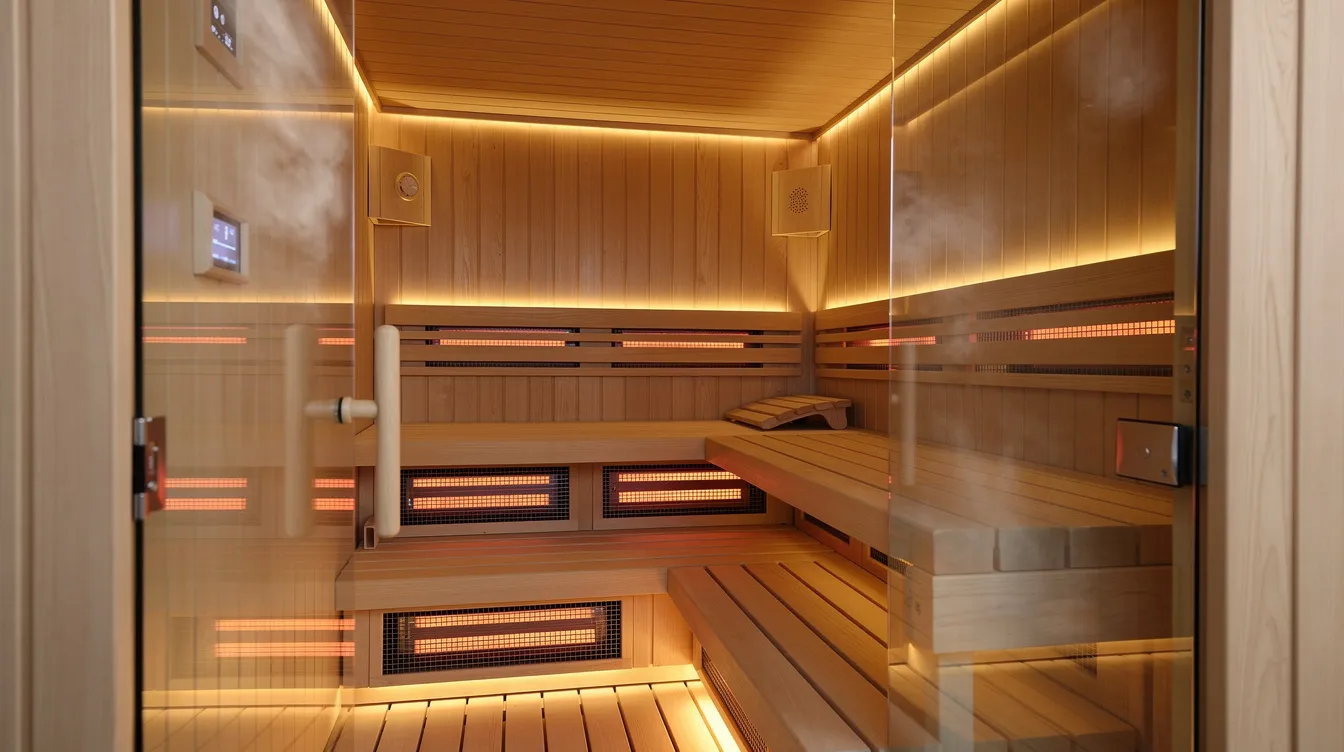
The theoretical promise sounds compelling: near infrared for skin health and cellular energy production, mid infrared for joints and improved circulation, and far infrared for deep warmth, cardiovascular benefits, and sustained sweating.
Experts do support some of these claims, but context matters enormously. Studies on near infrared (typically 630-850 nm) demonstrate improved mitochondrial function, wound healing, and collagen production when delivered at the correct dose and distance. Far infrared has 20+ years of clinical data from Finland and Japan showing benefits for blood pressure, cardiovascular health, and pain relief at 120-150°F.
However, real-world engineering creates significant limitations that rarely appear in marketing materials.
What Is the Distance Problem with Full Spectrum Sauna NIR?
Sauna users typically sit 40-80 cm away from front emitters. Most photobiomodulation studies use 5-20 cm. This distance dramatically reduces the irradiance reaching your skin, making the NIR component far less effective than clinical research suggests it could be under controlled conditions.
What Is the Power Density Gap in Consumer Full-Spectrum Models?
Clinical red light therapy research uses 20-60 mW/cm2. Many "full-spectrum" halogen strips inside cabins deliver well below this threshold, making effects minimal regardless of how warm the cabin feels.
The far infrared panels still do the heavy lifting for infrared heat and sweat response in almost all consumer full-spectrum models on the market. The NIR component often functions more as a marketing feature than a therapeutic one.
Which Full-Spectrum Marketing Claims Are Accurate and Which Are Not?
Since full-spectrum language exploded in wellness marketing, claims have increasingly blended solid science with speculation. The following assessment covers the most common claims buyers encounter.
"Detox at a cellular level": Sweating from any heat source is primarily a thermoregulation mechanism. While small amounts of heavy metals can appear in sweat, your liver and kidneys handle major detoxification. Current evidence does not support a unique "cellular detox" from full-spectrum versus far-infrared alone.
"Burn up to 600 calories in 30 minutes": This extrapolates from older cardiovascular lab data. Actual calorie expenditure during sauna use is modest, comparable to moderate exercise like a brisk walk, regardless of spectrum designation.
"Full spectrum heals chronic disease": No infrared sauna should replace medical treatment for autoimmune conditions, cancer, or severe cardiovascular disease. Sauna use is supportive therapy at best.
"Near infrared equals medical-grade red light therapy": Therapeutic light research controls wavelength, intensity, and distance precisely. Most sauna bulbs optimize for ambient heat, not photobiomodulation dosing.
Red flags to watch for:
- Claims about "reversing aging" in 30 days with no dose or clinical trial references.
- Vague "NASA research" citations without differentiating lab LEDs from consumer bulbs.
- Promises of "complete detox of environmental toxins" or "1000% increase in mitochondrial function."
Home Sauna deliberately avoids exaggerated promises. The platform discusses benefits aligned with peer-reviewed research: relaxation, perceived pain relief, stress relief, improved sleep quality, and cardiovascular support with regular infrared sauna use.
What Hardware Problems Do Full-Spectrum Saunas Have That No One Tells You About?
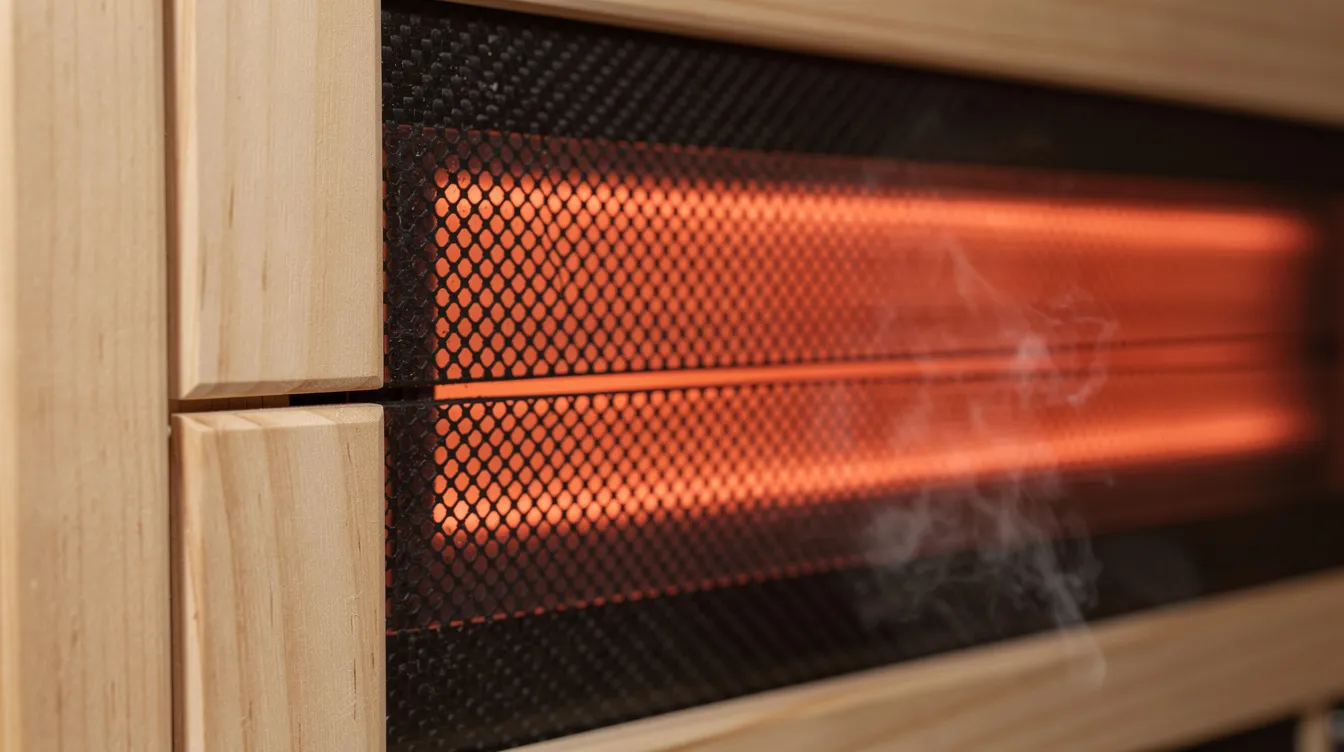
Near infrared is the most controversial element of full-spectrum design. Strong lab evidence exists for LEDs and lasers delivering specific wavelengths, but real questions remain about halogen and broad-spectrum emitters commonly found in cabins.
Typical "full spectrum" NIR hardware includes quartz halogen tubes near the front glass or above the door, incandescent red heat lamps at a distance, and low-output LED strips integrated into side walls (often more decorative than therapeutic).
Spectrometer testing by various brands between 2019-2025 shows most of these devices emit substantial visible and mid infrared light, with only modest true NIR within the 700-900 nm range, optimal for cellular benefits. Two additional safety and comfort issues have been identified in independent tests:
Halogen tubes reach extreme surface temperatures, forcing installation far from the skin, which greatly reduces any photobiomodulation effect. Some older full-spectrum models (pre-2022) showed elevated EMF fields of 12-20 mG near halogen housings, directly contradicting "ultra-low EMF" marketing.
Compare this to dedicated red light therapy panels: they use specified wavelengths (commonly 630, 660, 810, 830, 850 nm), deliver controlled irradiance at known distances, and do not primarily heat air, so they can safely be positioned close to skin.
For genuine skin rejuvenation or anti-aging benefits from light therapy, prioritize either well-designed LED NIR panels integrated properly, or pair a quality far infrared unit with a separate clinical-style red and NIR panel.
How Does Far Infrared vs. Full Spectrum Actually Differ in Your Day-to-Day Experience?
For most home users in 2026, the practical choice remains between a far infrared-only cabin and a more expensive full spectrum model. Here is what you will actually notice on a session-by-session basis.
Heat experience: Far infrared cabins typically operate at 120-140°F with gentle, enveloping warmth from carbon or ceramic panels. Full-spectrum units often feel slightly more radiant near halogen emitters, sometimes reaching 130-150°F. Unlike traditional saunas using extreme heat and steam, both deliver comfortable heat through direct infrared radiation rather than heating ambient air. Comfort depends more on build quality and heat distribution than marketing terminology.
Benefit overlap: Relaxation, stress relief, improved perceived recovery, muscle recovery support, and cardiovascular health benefits are largely similar between quality far infrared and spectrum infrared saunas. The clinical track record favoring far infrared therapy for whole-body heat therapy outcomes remains stronger.
Cost and maintenance considerations (2026 data):
|
Factor |
Far Infrared |
Full Spectrum |
|
Starting price (1-2 person) |
$2,500-$4,500 |
$3,000-$6,500+ |
|
Power consumption |
Baseline |
20-30% higher |
|
Maintenance |
Carbon panels rarely need replacement |
Halogen bulbs every 3,000-5,000 hours |
Home Sauna covers low-EMF far infrared cabins as the core recommendation for most buyers. For clients wanting a full spectrum, it prioritizes designs with independently controllable NIR emitters and transparent specifications, not decorative labels.
When Is Full Spectrum Worth It and When Should You Choose Far Infrared?

Some buyers are serious biohackers valuing every marginal benefit. Others simply want reliable daily heat therapy. The following framework helps you decide which investment makes sense for your specific situation.
Full spectrum justifies the premium when:
- You specifically seek combined heat and targeted skin or cellular support, and choose models with proven NIR and red LED panels.
- You are building a high-end luxury home sauna where budget is secondary and feature integration matters.
- You are an evidence-oriented consumer willing to experiment while understanding current limitations.
Far infrared is the smarter choice when:
- Your primary goals are stress relief, cardiovascular support, blood flow improvement, and general recovery, where FIR has strong clinical backing.
- Budget, energy efficiency, and simplicity matter more than incremental features.
- You plan to pair your sauna with a separate wall-mounted red and near-infrared LED panel for genuine photobiomodulation.
Home Sauna recommends most buyers start with a low-EMF far infrared model built from sustainably sourced wood like Canadian hemlock or cedar, then add red and NIR light panels as needed. You do not need "full spectrum" on the label to get 90% of well-documented sauna benefits. Pay extra only when additional hardware and specifications are genuinely transparent and aligned with your goals.
How Should You Evaluate Full-Spectrum and Light-Enhanced Saunas When Shopping?
Home Sauna serves wellness-oriented homeowners, athletes, and recovery-focused users who care about build quality and honest specifications over marketing hype. The following framework reflects that approach.
Core product philosophy:
- Low-EMF far infrared panels as the backbone of most cabins, where robust science and user satisfaction data exist.
- Sustainably sourced woods and thoughtful insulation ensuring cabins reach and hold 120-140°F efficiently.
- Plug-and-play electrical requirements (120V where possible for 1-2 person models) simplifying home sauna installation.
How to evaluate full-spectrum requests: Look for configurations where near infrared comes from dedicated LED or hybrid panels with known wavelengths (630/660/810/830/850 nm) and published approximate irradiance at typical seating distance. Think of NIR and red light as a separate but integrated tool layered onto a quality infrared sauna, not a magic upgrade that changes everything.
Additional options to consider: Outdoor and traditional Finnish-style saunas for those preferring intense heat around 180-200°F with longer sessions, sauna blankets for smaller spaces, and cold plunge tubs for contrast therapy, creating a comprehensive home recovery zone. Home Sauna covers the full range of these options in its best home sauna guides and reviews.
Make Your Home Sauna Decision Based on Science, Not Slogans
The full-spectrum sauna market rewards skepticism. The term carries no regulatory definition; the hardware delivering NIR in most consumer models is demonstrably underpowered for the cellular benefits often claimed, and far infrared remains the best-evidenced component of any infrared sauna experience. That does not mean full-spectrum saunas are worthless. It means they are worth scrutinizing before paying a significant premium.
A well-built, low-EMF far infrared sauna using quality carbon or ceramic panels will deliver the cardiovascular, relaxation, sleep, and recovery benefits that decades of peer-reviewed research actually support. If you want genuine photobiomodulation benefits on top of that, a dedicated clinical-grade red and NIR light panel used at the correct distance and power density is a more reliable and cost-effective approach than built-in halogen tubes positioned two feet from your skin.
Ready to invest in a genuinely full-spectrum sauna with verified wavelength delivery?
Contact Home Sauna today to explore systems with documented near, mid, and far infrared output, transparent testing data, and engineered heater technology that delivers all three wavelengths at therapeutic levels.
External References
- U.S. Federal Trade Commission: “Health Products Compliance Guidance.”
- Body Lab Studios: “Near, Mid, and Far-Infrared Wavelengths and Wellness Explained.”
- National Institutes of Health: “Effectiveness of 808 nm Near Infrared (NIR) Laser Photobiomodulation for Accelerating Post-Operative Wound Healing.”
- PubMed Central: “Adjunctive 830 nm Light-Emitting Diode Therapy Can Improve the Results Following Aesthetic Procedures.”
- Celluma Light Therapy: “Best LED Light Therapy Wavelengths for Skin, Pain & Recovery.”
- JAMA Internal Medicine: “Association Between Sauna Bathing and Fatal Cardiovascular and All-Cause Mortality Events.”
FAQs
Does a full-spectrum sauna detox more than a regular far infrared sauna?
No convincing human research shows that including near and mid infrared produces dramatically greater "detox" than a well-designed far infrared sauna alone. The measurable benefits linked to detox-style sweating, including improved circulation, mild blood pressure changes, and subjective feelings of cleansing, come from raising core temperature and sustaining sweat, which far infrared heat already delivers effectively. Your liver, kidneys, and lymphatic system remain primary detox organs. Research suggests a sauna supports those systems indirectly rather than replacing them. A 2015 Finnish cohort study found robust cardiovascular benefits from regular sauna use without any reference to spectrum designation.
Is near infrared in a full spectrum sauna the same as red light therapy?
Most near-infrared elements in consumer full-spectrum cabins are not equivalent to dedicated red light therapy devices used in clinical research. True photobiomodulation studies control wavelength, intensity measured in mW/cm2, and distance closely, while sauna bulbs optimize for heat and ambiance rather than precise dosing. For genuine cellular benefits or deep tissue penetration from light, either choose a sauna integrating proper red and NIR LED panels with known specs, or use a separate panel alongside a quality far infrared sauna.
Are full-spectrum saunas safe to use every day?
For most healthy adults, daily use of a properly built infrared sauna at moderate temperatures (120-140°F) is considered safe with proper hydration and attention to your body's signals. People with cardiovascular disease, low blood pressure, pregnancy, or implanted devices should consult a physician before regular sauna use, regardless of the spectrum. Responsible usage and medical guidance remain essential regardless of which sauna type you choose. Home Sauna's daily sauna use guide covers frequency, duration, and safety considerations in detail.
Does full-spectrum heat up faster or feel stronger than far infrared only?
Warm-up time depends more on heater wattage, cabin size, and insulation quality than spectrum designation. Some spectrum models feel more intense directly in front of halogen or NIR heating elements, but overall cabin temperature and sweat response are often similar to strong far infrared units. When comparing models, look at real wattage, heater coverage across back, sides, and floor, and verified user reviews rather than assuming "full spectrum" automatically delivers a stronger experience.
How do I know if a full-spectrum sauna's near-infrared is actually effective?
Ask brands for concrete specifications: exact wavelengths used (660, 810, 850 nm), approximate irradiance at realistic seating distances, and independent spectrometer or power-density test reports. Generic phrases like "powerful near infrared" or exceptional value claims without numbers are red flags. Effective systems share data openly. The U.S. National Institutes of Health's photobiomodulation research database provides a useful reference for the wavelengths and dosing parameters that have demonstrated measurable biological effects in peer-reviewed studies, giving you a benchmark against which to evaluate any manufacturer's claims.