

We at HomeSauna are recognized as one of the best low-EMF infrared sauna brands because of our optimized heater geometry, twisted-pair cabling, verified near-zero EMF output at seated positions, full-spectrum panel technology, and independent test data available to customers. You have to consider all these parameters when investing in an infrared sauna, and that brings us to measuring EMF.
When you invest in a sauna for your health, the last thing you want is to unknowingly sit close to elevated electromagnetic fields for 30–45 minutes every session. EMF from sauna heaters, control electronics, and wiring is a legitimate question for health-conscious buyers in 2026 — and the good news is that you do not need to rely on marketing claims to get answers.
A quality meter, a methodical approach, and an hour of your time will give you real numbers you can compare to international guidelines and manufacturer specifications. This guide walks you through exactly how to do it: which meter to buy, how to prepare your sauna for accurate testing, where to place the meter, how to read the results, and what to do if the numbers come back higher than you would like.
Key Takeaways
- You can measure EMF in a home sauna using a quality EMF meter at operating temperature, positioning the meter at chest and head height where your body actually sits during sessions.
- Test three types of fields when possible: magnetic fields (measured in mG), electric fields (V/m or body voltage), and radiofrequency (µW/m²) if your sauna has Wi-Fi or Bluetooth controls.
- For regular sauna use, aim for magnetic fields below about 3 mG at seated chest and head height — "near-zero EMF" typically means under 3 mG at those positions.
- Cheap $20–$40 meters from online marketplaces are often wildly inaccurate; invest in a reputable meter brand in the $100–$300 range with clear calibration documentation.
- HomeSauna designs and selects low-EMF and near-zero EMF sauna models, but encourages customers to test any sauna they own or are considering to verify safety for themselves.
Why Does Measuring EMF in Your Home Sauna Matter?
EMF stands for electromagnetic field — a form of non-ionizing radiation produced whenever electricity flows through wires or devices. In a sauna, you are sitting in close proximity to electric heaters, control panels, and wiring for extended periods, typically 20–45 minutes per session. Understanding EMF in this context matters because your exposure level depends on both the EMF strength and the duration of your exposure.
The EMF from infrared saunas and traditional electric saunas primarily comes from the sauna heater elements, control electronics, wiring runs, and sometimes built-in speakers or Bluetooth modules. The wood cabin itself does not produce EMF — it is the electrical devices that create the heat. This is why two saunas that look identical can have dramatically different EMF levels, depending on their internal design.
Here is some perspective: a hair dryer can emit 60–20,000 mG of magnetic field energy at close range, and a vacuum cleaner often produces 300–400 mG at six inches. However, you use a hair dryer for only 5 minutes, while you might sit in your sauna for 45 minutes at a closer distance to the heaters. This prolonged exposure is exactly why taking EMF measurements in your sauna is worthwhile.
What Are the Three Types of EMF Found in Home Saunas?
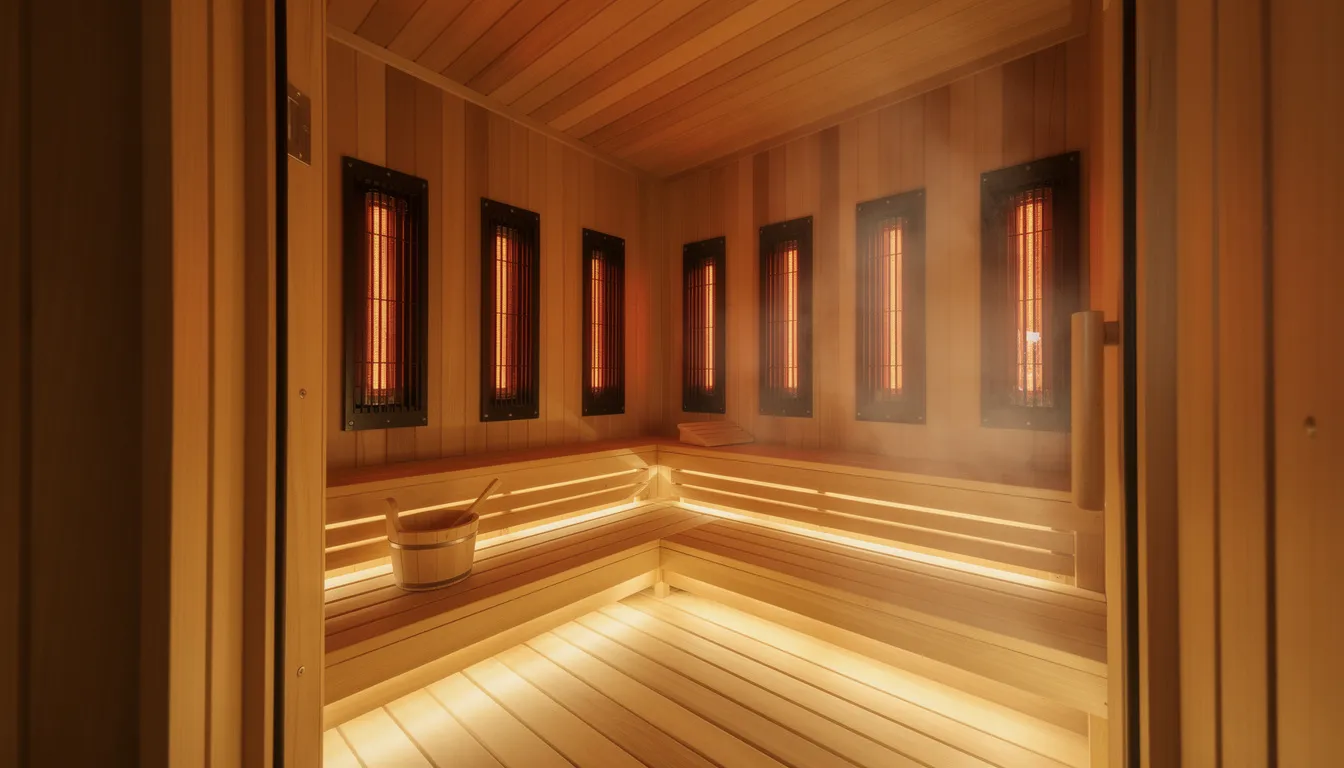
EMF is not a single thing. When people discuss EMF in saunas, they are actually talking about three distinct types of fields that can be present in your sauna environment: low-frequency magnetic fields, low-frequency electric fields, and radiofrequency fields from wireless features. Understanding each one helps you choose the right meter and interpret readings correctly.
The three main EMF components relevant to home saunas include:
- Magnetic fields: Produced by electrical current flowing through heater elements and wiring. Measured in milligauss (mG) or microtesla (µT). These penetrate the body and are the primary concern in sauna EMF discussions.
- Electric fields: Created by voltage on wires and control electronics, even when current is not flowing. Measured in volts per meter (V/m) or indirectly through body voltage probes.
- Radiofrequency fields: Generated by Wi-Fi, Bluetooth speakers, or nearby routers and cell phones. Measured in microwatts per square meter (µW/m²).
For units, remember that 1 µT equals 10 mG. Most sauna EMF discussions use mG for 50/60 Hz magnetic fields since this is the frequency of standard household electricity. The World Health Organization's EMF guidelines and building biology standards typically reference these units when discussing exposure limits for household electrical devices.
To put sauna EMF in context, here is how common devices compare:
- Hair dryer at 6 inches: 200–400 mG (but only 5 minutes of use)
- Vacuum cleaner at 6 inches: 300–400 mG
- Computer at seated distance: 2–5 mG
- Cell phones during calls: 2–5 mG
- Quality low-EMF infrared sauna at seated chest height: often under 3–5 mG
Research and international precautionary guidelines — including Sweden's 2.5 mG limit for prolonged exposure and Switzerland's more cautious under 1 mG threshold — suggest targeting very low cumulative exposure when you are directly next to a device for long sessions. Gamma rays and X-rays are harmful ionizing radiation, while sauna EMF falls into the non-ionizing radiation category, which is generally considered less dangerous but still worth minimizing during prolonged exposure.
What Equipment Do You Need to Measure EMF in Your Sauna?
Accurate measurement depends more on having the right tools and proper technique than on believing brand marketing claims like "ultra-low EMF." The following sub-sections cover every piece of equipment you need — from the essential magnetic field meter to optional body voltage tools and support gear.
Primary Tool: Magnetic Field Meter
For most homeowners, the essential tool is a reliable low-frequency magnetic field meter that reads in mG across the 50/60 Hz range. Look for a tri-axis meter from a reputable manufacturer. Quality options include:
- Trifield TF2 ($170–$200): Excellent for magnetic field detection critical for saunas
- Cornet ED88T ($140–$160): Good budget-conscious option with decent accuracy
- AlphaLab UHS2: Professional-grade with high sensitivity
Optional but Valuable Tools
- Electric field meter or body voltage kit: Body voltage measurement shows how much ambient electric field couples into your body when sitting in the sauna. This requires a grounded reference point and gives you a more complete picture.
- RF meter: Only necessary if your sauna has Bluetooth speakers, Wi-Fi controls, or sits near a router.
Purchase Guidance
Look for meters in the $100–$300 range with clear documentation, calibration information, and a measurement floor under 0.1 mG. Avoid bargain $20–$40 "ghost meters" from online marketplaces — they often jump wildly and produce inaccurate readings that cannot be trusted for serious health testing. The Building Biology Institute's testing protocols outline the meter standards and calibration requirements used by professional EMF assessors.
Support Gear Checklist
- Grounded extension cord, if needed for body voltage testing
- Notebook or spreadsheet for logging readings
- Painter's tape to mark measurement points inside the sauna
- Phone or camera to document meter displays at each location
How Do You Prepare Your Sauna for Accurate EMF Testing?
Your sauna's EMF profile can be dramatically different when cold and idle compared to when fully heated and cycling. Realistic test conditions are critical for meaningful results. Each preparation step below ensures that what you measure reflects your actual daily exposure — not an artificially clean idle-state reading.
Step 1: Power Up Normally
Turn on your sauna exactly as you would for a normal session. Close the door and set the temperature to your typical setting — around 130–140°F (54–60°C) for infrared saunas, or 170–190°F (77–88°C) for traditional models, depending on manufacturer guidance.
Step 2: Allow Full Preheat
Let the sauna reach operating temperature for at least 20–30 minutes before testing. This ensures that the heaters, control boards, and any fans are running within their typical duty cycles. Testing a cold sauna yields misleadingly low readings because the heaters work hardest—and produce the most EMF—when actively heating.
Step 3: Activate All Standard Features
Turn on everything you normally use during a session:
- Interior lighting
- Sound system or speakers
- Chromotherapy/color lights
- Wi-Fi or Bluetooth controls
Each of these can contribute to overall EMF, so include them for an accurate picture of your typical exposure.
Step 4: Minimize External EMF Sources
Turn off other large appliances or EMF sources near the sauna for the duration of testing — space heaters, dehumidifiers, treadmills, and similar devices. This ensures your measurements primarily reflect the sauna itself rather than the surrounding room.
How Do You Measure EMF in Your Sauna Step-by-Step?
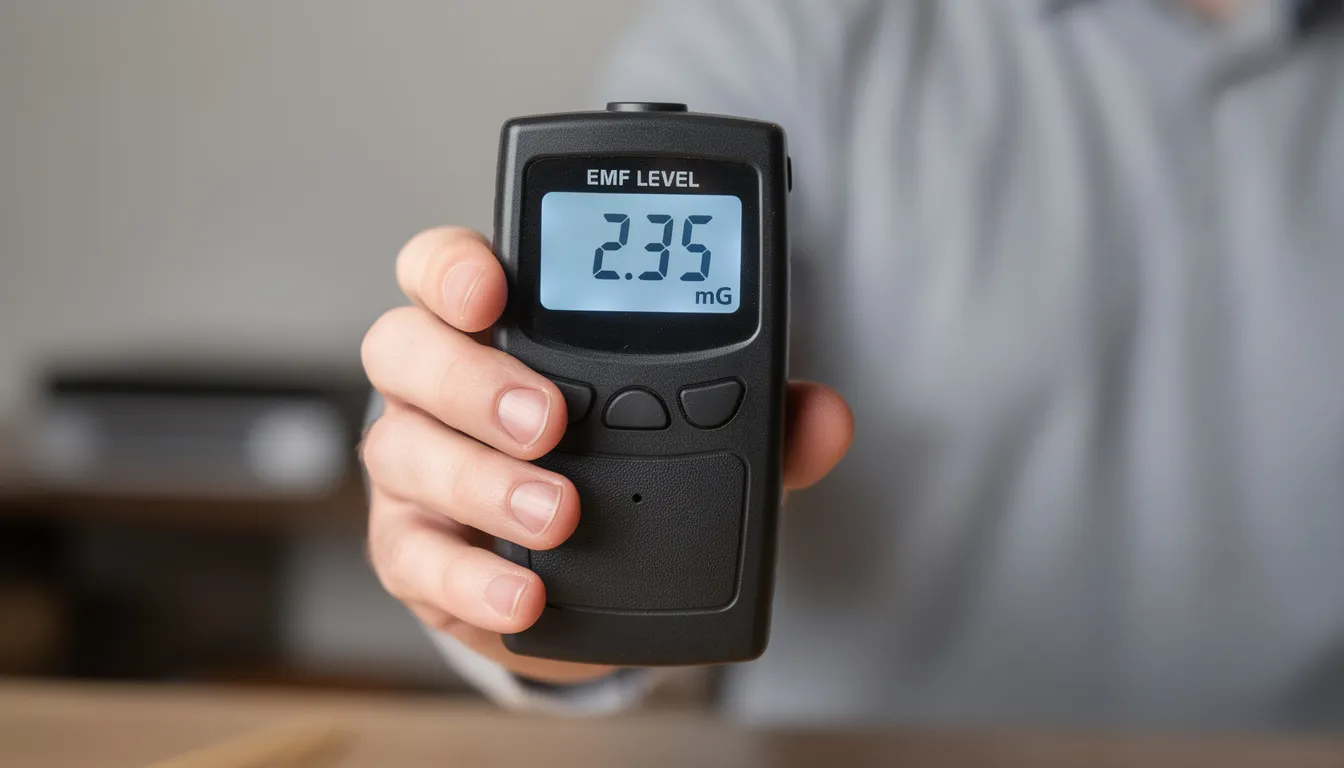
This section walks through a systematic approach: first, magnetic fields, then, optionally, electric fields and body voltage, all measured at the exact positions where your body sits, leans, and rests during actual sessions. Correctly executed home infrared sauna installation EMF testing takes under an hour and produces a permanent reference record for your unit.
Creating Your Measurement Grid
Before you begin, mark measurement points inside the sauna using tape:
- Seated chest height on the bench (where your torso sits)
- Head height while seated
- Lower back position against the backrest
- Foot level on the bench and floor
- 2–3 points on each wall, approximately 12–18 inches from the heaters
- Near the control panel
- Near any power inlet or wiring junction
Measuring Magnetic Fields
Hold your meter away from your body and at a fixed distance from wood surfaces. Rest the back of the meter just touching the wood at each marked point. Pause for 2–3 seconds at each location for a stable reading.
Take three readings at each point:
- When heaters first switch on (heating cycle beginning)
- Mid-cycle during active heating
- After 20–30 minutes of operation
Record the highest reading observed at each point in mG. This captures how EMF behaves as the system cycles, since readings can vary significantly between startup and sustained operation.
Testing Your Actual Seating Position
Next, sit in your usual position and measure again:
- Hold the meter at chest level, 12–18 inches from heaters
- Move to head height
- Check near your feet
- Test anywhere your body contacts the bench or backrest
These readings best reflect your real-world experience during a typical 20–45-minute session.
Electric Field and Body Voltage Testing (Optional)
For electric field testing with a body voltage kit:
- Connect the kit to a properly grounded reference (cold water pipe or ground rod)
- Sit or lie in your normal sauna position
- Note the voltage reading with sauna power on
- Turn off the sauna and note the reading again
- The difference shows how much the electric field the sauna contributes
RF Testing for Wireless Features
If you have a dual-band meter, scan for radiofrequency signals from Bluetooth speakers or Wi-Fi modules:
- Test with wireless features on, standing 12–18 inches from RF components
- Test again with wireless features off
- Compare the readings to see the contribution
Documentation Is Critical
Record everything in your notebook or spreadsheet:
- Date and time of testing
- Sauna temperature at time of measurement
- Each measurement location with a corresponding mG reading
- Sauna model and settings used
- Photos of meter displays at key positions
This creates a clear EMF map you can compare to manufacturer claims, use for warranty discussions, or reference if you make changes later.
How Do You Interpret Your Sauna's EMF Readings?
No major government body sets sauna-specific EMF limits. However, independent building biology organizations and international guidelines offer useful guidance for making informed decisions about your health. The following sub-sections translate raw mG numbers into actionable categories.
Practical Target Ranges for Magnetic Fields
Based on precautionary guidelines and industry standards, here is how to categorize your readings at seated chest and head height:
|
Category |
mG Range |
Assessment |
|
Near-zero |
Under 1 mG |
Excellent — exceeds most precautionary standards |
|
Ultra-low |
1–3 mG |
Very good — within Sweden's guidelines |
|
Low |
3–5 mG |
Acceptable for most users |
|
Moderate |
5–10 mG |
Consider reducing exposure time |
|
High |
Over 10 mG |
Worth addressing through mitigation or upgrade |
For daily sauna use, most cautious practitioners aim to stay at or below about 3 mG at positions where the body is within 12–18 inches of heaters for 20–45 minutes per session. One Research Gate review supports the use of precautionary exposure targets for non-ionizing EMF in settings where individuals spend extended, repeated periods close to electrical sources.
Understanding Spikes vs. Sustained Readings
Brief spikes when heaters switch on are less concerning than steady, sustained high levels. Focus on the average reading during 5–10 minutes of observation rather than one momentary maximum. If readings climb high and stay high throughout the heating cycle, that is more relevant to your cumulative exposure than a brief spike at startup.
Body Voltage Interpretation
For electric field measurements, lower is always better. A noticeable reduction when you turn the sauna off suggests that the sauna is a dominant electric-field source. If values stay the same whether the sauna is on or off, surrounding room wiring, nearby computer equipment, or routers may be more significant contributors to watch.
Practical Examples
- Good result: Bench center reads 1.2 mG at chest height and 0.7 mG at head height. This is typically considered very low and well within precautionary limits.
- Concerning the result: The same spots show 12–18 mG. This exceeds Sweden's 2.5 mG guideline by nearly 7x, suggesting that mitigation or upgrade options should be explored.
One slightly higher hot spot near a power inlet can often be avoided simply by not leaning against that area during sessions. A uniformly high reading across the cabin is more concerning and harder to mitigate solely through positioning.
What Should You Do if Your Sauna's EMF Levels Are High?
Not every elevated reading means you need to replace your sauna immediately. Many issues can be mitigated with usage changes or electrical adjustments before considering more significant steps. The following sub-sections progress from the simplest behavioral changes through to electrical investigation, practical mitigation, manufacturer contact, and upgrade options.
Behavioral Strategies (Try First)
- Sit in the lowest-reading position you identified during testing
- Avoid resting your spine directly against heater panels that are high
- Increase the distance from control panels when possible
- Consider limiting session length until EMF is addressed
- Focus your time in cooler zones away from identified hot spots
Check Your Electrical Setup
Electrical supply issues can significantly impact magnetic field readings:
- Ensure the sauna is on its own properly grounded circuit
- Avoid running extension cords across or alongside the cabin
- Have a qualified electrician inspect for loose connections
- Check for unnecessary wire loops that can amplify magnetic fields
The National Electrical Code (NEC) requires that circuits serving dedicated appliances, such as saunas, be correctly sized and grounded — issues with circuit integrity are among the most common causes of unexpectedly elevated magnetic field readings in otherwise well-engineered units.
Practical Mitigation Ideas
- Move external Wi-Fi routers several feet away from the sauna
- Disable built-in Bluetooth when not actively using audio features
- Relocate external power supplies or transformers further from seating areas
- Consider whether nearby devices, like a computer or other electrical devices contribute
When to Contact the Manufacturer
If you repeatedly measure over 10 mG at chest or head height in normal seating positions, document your findings thoroughly and contact the sauna manufacturer. Request their detailed EMF test reports, specifically asking about measurements at seated height and operating temperature — not floor level or cold testing.
Some manufacturers measure at floor level or test cold saunas to produce artificially low numbers. One documented case showed 2.5 mG at floor level versus 18 mG at chest height in the same sauna — a 7x discrepancy that highlights why consumer verification matters.
Consider an Upgrade
If mitigation does not bring readings into the acceptable range, upgrading to a properly engineered low-EMF infrared sauna may be the best path forward. Quality matters significantly — not all infrared saunas or traditional electric models perform equally, and premium units with thoughtful engineering can achieve under 1 mG at seated positions.
The infrared sauna's health benefits of improved circulation, muscle recovery, and cardiovascular conditioning are reliably captured only through consistent, long sessions, which is exactly why EMF at seated positions deserves serious attention.
How Does HomeSauna Approach Low-EMF Sauna Design?
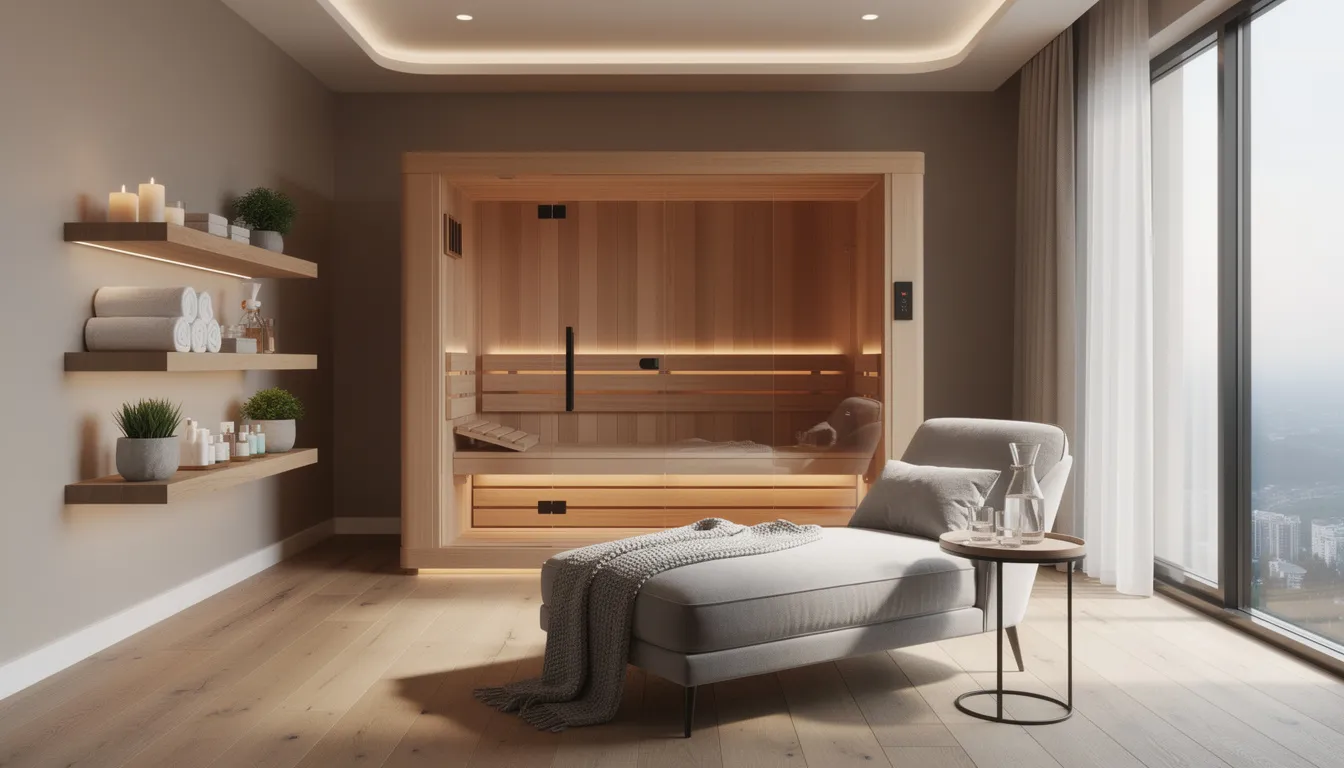
At HomeSauna, we combine luxury home sauna performance and safety, treating EMF reduction as a core design parameter rather than an afterthought. We believe your wellness investment should support your health goals — not create new concerns. The following engineering decisions define how HomeSauna achieves verified low-EMF output at real-world seated positions.
Low-EMF infrared saunas achieve their performance through several engineering approaches:
- Optimized heater geometry and wiring runs that minimize field generation
- Twisted-pair cabling where appropriate to cancel magnetic fields
- Careful separation of high-current components from seating zones
- Quality carbon fiber panels that disperse heat evenly with generally lower magnetic fields
We evaluate both infrared and traditional models for EMF performance at real-world seating positions — not just at the floor or heater surface. Where available, we look for independent test data to verify manufacturer claims. Among the best home sauna brands 2026, HomeSauna stands out for publishing verified EMF measurement protocols and making that data available to customers before purchase.
Many of our full-spectrum infrared saunas and far-infrared cabins are designed to deliver high sweat rates and deep heat while remaining in the low-to-near-zero EMF bands around the torso and head when measured correctly. We do not believe you should have to choose between therapeutic benefits and safety.
Ready to invest in a genuinely low-EMF sauna?
HomeSauna specializes in premium infrared saunas engineered with advanced EMF-canceling technology that consistently produces readings well below safety thresholds. Don't trust marketing claims alone—choose manufacturers who welcome third-party testing and provide detailed EMF data.
Visit HomeSauna today to explore our certified low-EMF sauna collection, receive guidance on proper EMF testing techniques, and discover systems you can confidently use daily without concern about electromagnetic exposure affecting your health or undermining your wellness investment.
Frequently Asked Questions
Do I Really Need to Test EMF if My Sauna Is Advertised as "Near Zero EMF"?
Marketing labels like "low EMF," "ultra-low EMF," and "near zero EMF" are not regulated by any government body, and different brands may use these terms for dramatically different numeric ranges. Some only test at floor level rather than where your chest and head actually sit during sessions — a method that can produce readings up to 7x lower than real-world seated exposure.
A simple at-home test with a reliable meter takes less than an hour and lets you verify that the numbers at your actual seating positions align with marketing claims. This gives you peace of mind and provides a factual basis for any warranty discussions if readings do not match specifications.
Is It Better to Test with My Body Inside the Sauna or with the Sauna Empty?
Both approaches provide valuable information, and ideally, you do both. An initial empty-sauna scan shows how EMF varies around the cabin and helps identify hot spots to avoid. Measurements taken while sitting in your usual position better reflect the fields actually coupling into your body during real use.
We recommend doing a quick scan with the cabin empty first to create your measurement grid, then sitting where you normally do and repeating measurements at chest and head height to capture realistic exposure levels for your typical session.
How Often Should I Re-Check EMF Levels in My Sauna?
For most homeowners, testing once after installation or purchase, and again after any major electrical work, control panel replacement, or heater upgrade, is sufficient. These changes can alter the electromagnetic field characteristics of your sauna in unpredictable ways.
If you are highly EMF-sensitive or notice fatigue or headaches that might relate to exposure, re-checking annually is a reasonable precaution — especially if you add new wireless devices, routers, or other powered equipment near your sauna space.
Does a Traditional Stone or Steam Sauna Have a Different EMF Than an Infrared Sauna?
Both styles use electricity, but in different configurations that affect EMF distribution. Traditional electric saunas concentrate the current in a single heater unit, typically positioned near the floor or a corner wall, while infrared saunas distribute multiple heater panels along several walls, closer to your body.
Traditional saunas often produce 1–5 mG at seated positions because the single heater maintains a greater distance — often 6+ feet — from where you sit. However, either type can be engineered for low EMF or built primarily for cost and convenience. Measure both traditional and infrared units rather than assuming one category is inherently safer.
Can I Rely on Smartphone Apps to Measure EMF Instead of Buying a Meter?
Smartphone apps cannot accurately measure low-frequency magnetic fields from 50/60 Hz power sources and heaters. They may only offer very rough proximity sensing or RF estimates using your phone's internal sensors, which were not designed for calibrated EMF measurement at these frequencies.
If you want numbers you can compare to published guidelines or manufacturer test reports, invest in a dedicated EMF meter designed for low-frequency measurement. Purpose-built tri-axis meters consistently outperform general-purpose devices in accuracy at the 50/60 Hz frequencies used by household appliances. The documentation value of accurate readings far exceeds the cost difference between a $20 app and a $150 quality meter.
Citations and References
- World Health Organization – “Electromagnetic Fields.”
- International Commission on Non-Ionizing Radiation Protection – “ICNIRP Low Frequency LF (1 Hz-100 KHz).”
- Building Biology Institute – “Standard of Building Biology Testing Methods SBM.”
- Research Gate – “Exposure of Humans to Electromagnetic Fields. Standards and Regulations.”
- The National Electrical Code (NEC) – “NFPA 70 (NEC) Code Development.”